
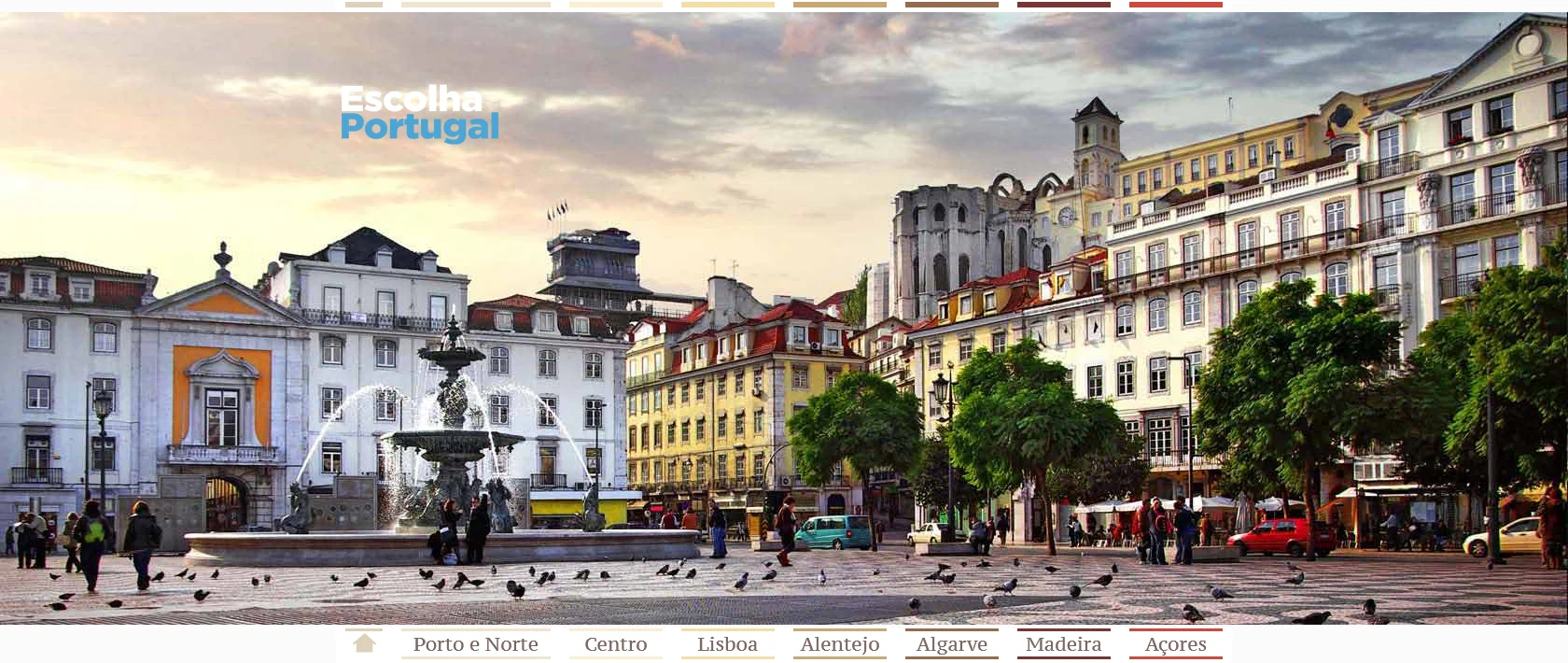

Turismo de Portugal was inviting Portuguese citizens to rediscover their own country — a campaign aimed at internal tourism, region by region, anchored in editorial storytelling and curated promotional offers. The website needed to carry the emotional weight of the campaign — the landscapes, the food, the saudade of small inland towns — while still functioning as a tool for finding deals and planning trips.
The two ambitions don’t naturally cooperate. Marketing wants cinematic; conversion wants filters. Both are right.
The shorthand brief I gave myself: cinematic enough to anchor a national campaign, structured enough to drive bookings. Anything that pulled too far in either direction got cut.
Seven small sites inside one frame. Each region got its own dedicated subpage with its own narrative arc — hero photography, themed travel ideas, curated offers. The user always knew which region they were in. Cross-region navigation existed but didn’t dominate; the priority was depth per region, not breadth across regions.
Filters rendered as icons, not form fields. Activity, accommodation type, offer category — all clickable visual chips. The interface stayed image-led even at its most utilitarian. A small thing, but it changed the emotional register from “search engine” to “magazine flicking.”
Offers opened in modals, never in new pages. Click an offer card, and the offer surfaced over the regional context rather than replacing it. The user could compare offers without losing the regional immersion. Closing the modal returned them to where they were.
Each region carried its own accent colour. Calibrated to evoke geography rather than picked arbitrarily. The Algarve in warm coral; the Alentejo in earth and gold; the Açores in deep ocean blue. The chrome shifted subtly as the user moved between regions. The colour told you where you were before the headline did.
Middle page area with random offers to country areas
The published version sits at the balance point because the regional pages were built as story arcs first and the offer cards were dropped in as natural punctuation, not as the structural skeleton. Early drafts leaned too magazine; the offers drowned. Later drafts leaned too directory; the romance died.