
Guerra & Paz
A publisher’s first website, designed like a publisher’s book. An editorial digital identity for one of Portugal’s most distinctive independent publishers.
The Challenge
There are publishers, and then there are publishers like Guerra & Paz: a catalogue that swings — wildly, unapologetically — from translated classics to political essays to biographies of people whose biographies nobody else was rushing to publish. The covers look like nothing else on the Portuguese shelf. Loud, graphic, sometimes deliberately ugly in the way that good books are sometimes deliberately ugly. Designing their first website was less a brief than an inheritance.
Most publisher websites at the time defaulted to one of two templates. Either the e-commerce grid, with book covers arranged like supermarket cans, or the press kit, with company history at the top and the catalogue tucked underneath like a footnote. Neither was Guerra & Paz. The first treated books like products; the second treated readers like investors.
The site needed to be a continuation of the publisher’s printed personality — the same audacity, the same colour, the same disinterest in being polite — but in a medium that had its own gravity, its own habits, its own readers.
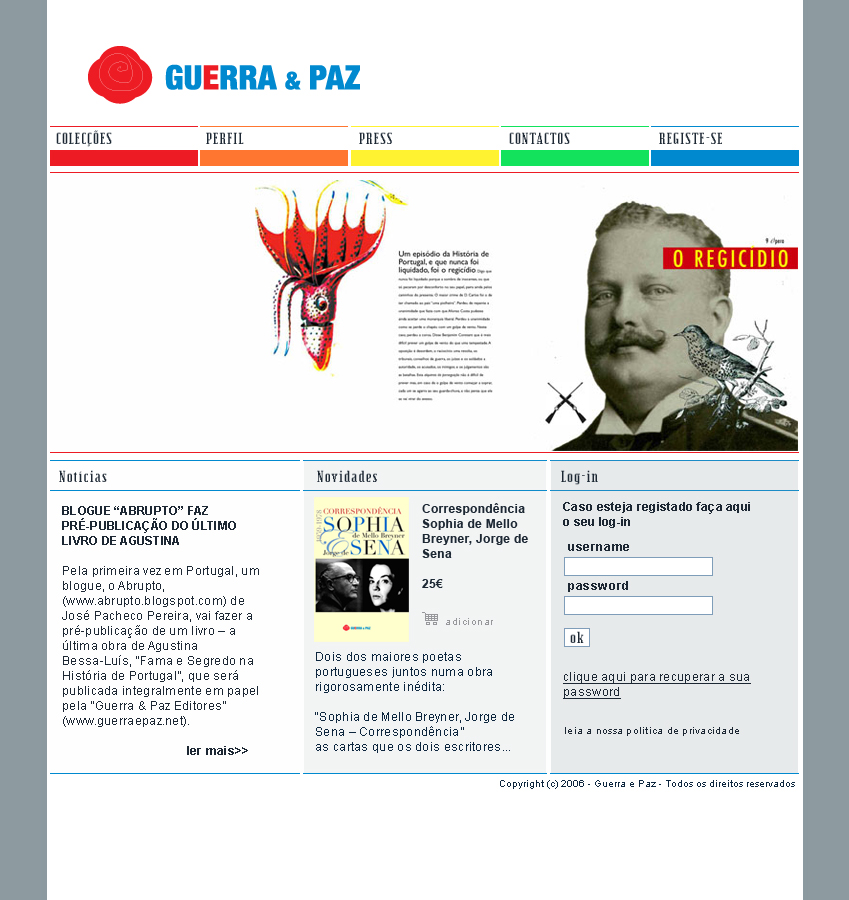
home page
Approach
The navigation became the publisher. Rather than treating the menu as utility chrome, I built it from the chromatic stripes that defined the catalogue: each top-level category got its own colour, drawn from the spines and covers of the books themselves. The menu bar became, accidentally and on purpose, the most recognisable element of the site.
The homepage as collage, not catalogue. Book covers, historical portraits, typographic fragments — laid out asymmetrically, with the same disregard for the rectangular grid that the publisher’s covers showed. Closer to a literary spread in a thoughtful magazine than to a corporate front page.
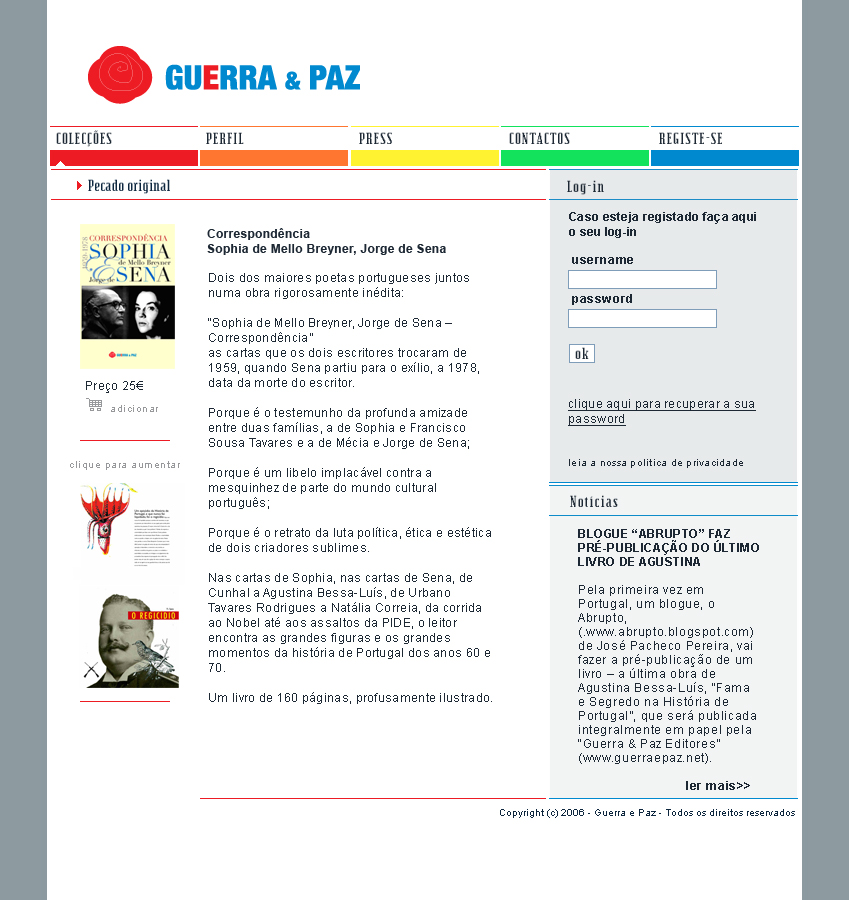
A typographic argument. A classical serif for body and titles; a clean sans for navigation and captions. The pairing was a small theological statement: this is a publisher whose work sits in the conversation between scholarly tradition and contemporary irreverence, and the typography should acknowledge that.
book page
Outcome
The site gave Guerra & Paz a digital presence that read like the books it sold. New collections were added over the years without breaking the structure. The chromatic stripe nav held up. The homepage collage adapted as new books arrived without requiring a redesign every season.
The choice I’d defend most stubbornly is the refusal to surface the buy button. It’s there; it’s not the point. The site was designed to make readers want the catalogue first, and the buy button is a quiet consequence of that wanting. Most publisher sites lead with the buy button and wonder why their readers feel like customers. We led with the work and got readers in return.